Tankless water heater maintenance costs depend on four things. These are how hard your water is, how often the unit gets flushed, whether the heater has isolation valves for easy service, and how complex the unit is. Water hardness is the biggest swing factor in this part of New Jersey.
We do not quote prices in a blog post because no honest figure fits every house. Instead, this guide shows what pushes the bill up or down so you can plan and compare estimates fairly.
By the Morristown Express Plumbing team. Published October 30, 2026. Updated October 30, 2026.
The main cost drivers
Use this list as a reference when you compare service offers.
- Water hardness, which sets how fast scale builds on the heat exchanger
- Flush frequency, since skipped flushes turn a routine job into a repair
- Isolation valves, which make flushing quick when installed and slow when missing
- Gas or electric model, since each has different parts to check
- Venting condition, filters, and the age of the unit
- Access, meaning whether the heater is in a clear basement wall or a cramped closet
What a maintenance visit covers
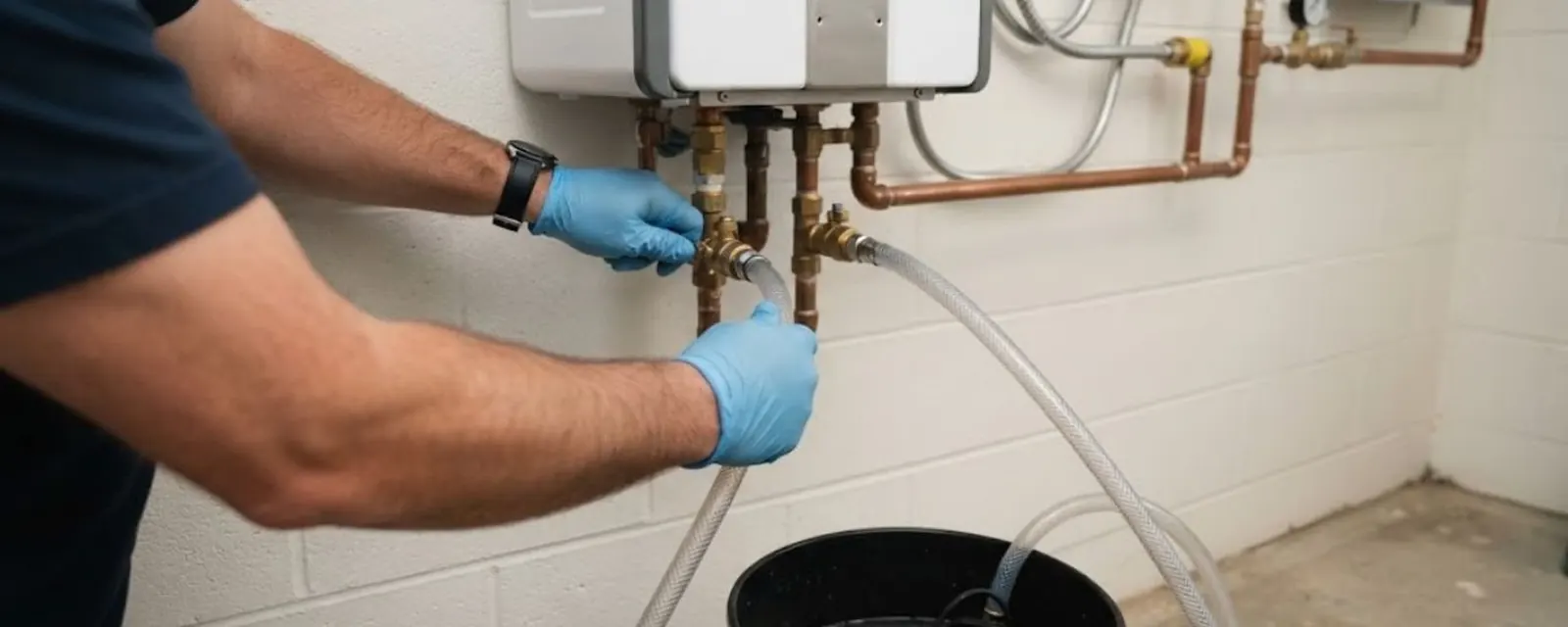
A technician isolates the unit, connects a pump and hoses, and circulates a descaling solution through the heat exchanger. They rinse it, check inlet screens or filters, inspect the venting, and review error codes. Gas models also get burner and combustion checks.
The work is straightforward on a well-installed unit and slower when valves are missing or the space is tight. Time on site is a large part of the price, so access matters more than most owners expect.
How each factor changes the cost of upkeep
No dollar figures here, only the direction each factor pushes.
| Factor | Effect on maintenance cost | What you can do |
|---|---|---|
| Harder water | Raises it, more frequent descaling | Test the tap, flush on a schedule |
| No isolation valves | Raises it, slower service | Have valves added at the next visit |
| Skipped flushes | Raises it, risk of repair | Calendar a regular reminder |
| Easy access | Lowers it | Keep the area clear |
| Newer, simpler unit | Often lowers it | Follow the maker's service guide |
Hard water and scale
Scale is a mineral crust that forms on hot surfaces. It narrows passages, lowers efficiency, and triggers error codes that sometimes look like a failed part. Descaling more often in hard water is cheaper than letting scale build up until a component fails.
If you are unsure how hard your water is, test the tap with a basic kit. A water softener or scale inhibitor upstream of the heater can lower the long-term maintenance load, though it adds its own upkeep.
DIY flush versus a plumber
Many owners with isolation valves flush the unit themselves with a pump and a descaling solution. That is reasonable if you follow the maker's instructions and shut off power or gas first. DIY stops making sense when there are no valves, when the unit shows repeated error codes, or when a gas smell or venting problem appears.
Our licensed plumbers can service a tankless water heater, add isolation valves, and diagnose faults. If the exchanger is failing, we will say so honestly and discuss water heater repair against replacement.
Planning ahead without a price tag
Because we cannot quote a number that fits every home, the useful step is to gather facts. Know your unit's model, its age, whether isolation valves exist, and when it was last flushed. Bring your water test result if you have one.
With those facts, any contractor can give you a specific written estimate rather than a guess. Compare two or three on scope, not only on the final figure.
Signs the unit needs service sooner
Watch for fluctuating water temperature, longer waits for hot water, reduced flow, odd noises, or error codes that return after resetting. These often point to scale or a blocked screen, and they are cheaper to fix early than late.
Ignoring them lets minerals harden into a layer that is harder to dissolve and may shorten the life of the heat exchanger.
Ways to lower upkeep over time
Install isolation valves if they are missing. Keep a service log on the wall next to the unit. Flush on a schedule that fits your water, not a calendar average. Keep the air intake and vent clear of lint and debris.
If scale pressure is high, ask a plumber about a softener or an inline scale inhibitor and weigh its upkeep against the savings.
Questions to ask when you get an estimate
Ask what the visit includes, such as flushing, filter cleaning, vent inspection, and a written report. Ask whether isolation valves are present and what adding them would involve. Ask how the contractor will handle disposal of the used descaling solution.
Request the price in writing before work starts, and compare line items rather than totals. If one estimate leaves out the valves or the venting check, that gap explains the difference.
Finally, ask how often they recommend service for your water. A contractor who has seen the local results should give you a reasoned answer, not a stock one.
Why maintenance beats repair
Skipped service shows up later as a repair bill, and repairs on a scaled heat exchanger are more involved than a flush. A small, regular visit keeps the unit within its design limits and tends to hold efficiency steady.
Warranty terms from the maker often expect proof of service, so keep your records. If a past owner never flushed the unit, say so when you call. The technician will plan for extra descaling time, and that honest starting point keeps the estimate close to the final bill.
Keep a simple service log
Write the date, the work done, and any error codes on a card taped near the unit. A log shows the next technician what has already been tried, and it makes it easier to spot a pattern, such as codes that return a few weeks after each flush. Patterns like that point to a hard-water issue or a failing part, and they help a contractor give you a firmer scope.
Morristown, NJ: why the hardness range matters
According to the Southeast Morris County Municipal Utilities Authority 2024 water quality report, hardness in its system ranged from 29 to 400 mg/L, which is 1.7 to 23.4 grains per gallon. SMCMUA blends reservoir water, local groundwater, and purchased supplies, so a street's hardness can change by season. That is a big spread for a tankless heater, because the high end scales a heat exchanger much faster than the low end.
Test your own tap rather than assuming. The same utility serves Morristown and Morris Plains, and it reaches customers in Morris Township. Households in Madison are served by the borough water utility, so their results may differ.
Frequently asked questions
The maker's manual gives the baseline. In harder water, more frequent flushing is wise, and a test of your tap helps you set the schedule.
Often yes, if isolation valves exist and you follow the instructions. Without valves, or with repeated errors, call a plumber.
Common causes are scale, a clogged filter, a venting issue, or a failing part. A plumber can read the code and check each in order.
It can reduce scale, which lowers descaling needs, though the softener has its own upkeep. Ask a plumber whether it suits your water.
Not necessarily. The tasks differ, and neglect costs more in either case. Skipping flushes is the usual way a tankless unit gets expensive.
SMCMUA reported hardness of 29 to 400 mg/L in 2024, depending on source blending. Test your tap or read the utility's report for your street.