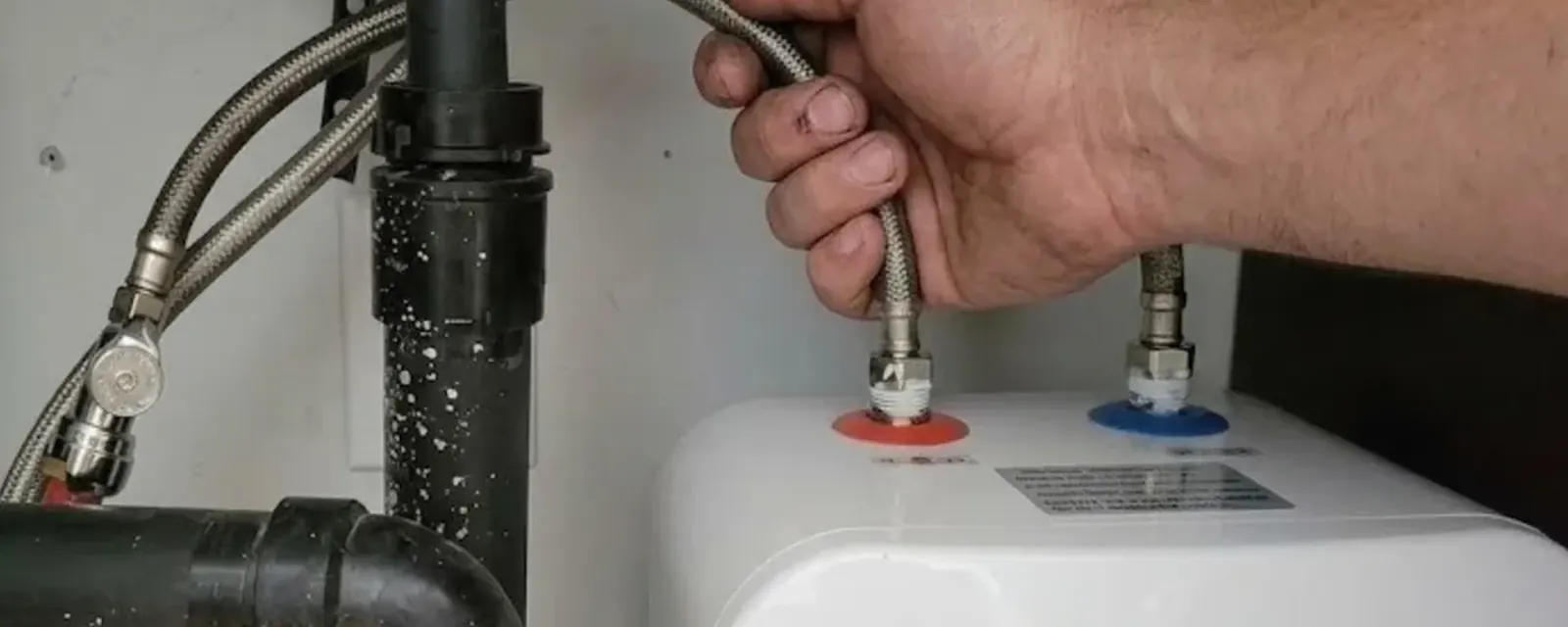
An under-sink water heater is a small point-of-use unit that sits in the cabinet and heats water right at one faucet. It fixes the long wait for hot water at a kitchen, bar, or bathroom sink that sits far from your main heater. A typical install needs cabinet space, a cold water connection, a power source, and a safe place for relief valve discharge.
A confident DIYer can swap a like-for-like unit. A first-time install usually calls for a licensed plumber, because the water, power, and safety parts all have to be right together.
By the Morristown Express Plumbing team. Published October 30, 2026. Updated October 30, 2026.
Which type fits under a sink
Two designs dominate. A mini-tank stores a few gallons and keeps them warm, so it delivers hot water instantly but only for a short draw. A compact electric tankless unit heats on demand with no storage, but it pulls much more electrical power while running.
For hand washing and rinsing dishes, a mini-tank is the simpler choice. For a bar or utility sink that needs longer runs of hot water, an on-demand unit may suit better, provided your panel and wiring can carry it.
Check the cabinet before you buy
Most installs fail at the planning stage, not the plumbing stage. Measure first and confirm each of these items.
- Interior cabinet height, width, and depth, including the space needed to reach the shutoff and relief valve
- A nearby outlet on a suitable circuit, or an electrician's plan to add one
- A cold supply line with a working shutoff valve
- A drain path or pan for the relief valve and for any leak
- Clearance so a tank can be flushed or replaced later without gutting the cabinet
- Floor strength, since a full tank adds real weight
Mini-tank, point-of-use tankless, or the main heater
Each option answers a different problem.
| Option | Best for | Watch out for |
|---|---|---|
| Under-sink mini-tank | Quick hot water for hand washing and rinsing | Short supply, needs a nearby outlet |
| Point-of-use tankless | Longer draws at one remote sink | High electrical load, scale buildup |
| Recirculation or main heater upgrade | Hot water slow at many fixtures | Larger job and cost |
How the installation goes
The plumber shuts off water at the sink, then tees a new line off the cold supply into the heater. A short hot line runs from the heater to the faucet. The relief valve is piped so any discharge goes to a drain or a pan, never onto the cabinet floor.
Next comes power, then filling the tank and bleeding air at the faucet before the element is switched on. Skipping that order burns out the heating element, which is a common reason a cheap install dies within a season.
Where DIY runs out
Cutting into supply lines and hanging a pressurized vessel over a finished cabinet is not forgiving work. A weeping fitting inside a cabinet can rot the floor of the unit for months before anyone sees it. If your cabinet has no outlet or your panel is full, you also need an electrician, and local rules on electrical work are worth confirming with the town construction office.
Our licensed plumbers install point-of-use units as part of water heater installation visits. If your whole house runs short on hot water, a full-size replacement or a tankless water heater may solve more than one small unit can.
Running costs and expectations
A small heater keeps its stored water warm all day, which uses a little power even when nobody is home. Some owners switch it off at a breaker overnight or while away. That is a sensible habit if the unit has no timer.
Hot water arrives fast, but a mini-tank gives you only a short burst. If someone showers after dishes, the pipe run from your main heater still matters, so expectations should match the size of the unit.
Mistakes that shorten the life of a small heater
Energizing the element before the tank is full is the classic error. It overheats and fails in seconds. Skipping the relief line is the next one, because a stuck valve with nowhere to drain floods the cabinet. A third mistake is stuffing the cabinet with cleaning supplies, which blocks airflow and hides slow leaks.
Give the heater breathing room, check the connections after a week, and wipe the cabinet floor once a month. A tiny weep caught early costs a fitting. The same weep found late costs a cabinet.
Alternatives worth weighing
If the real complaint is a long wait for hot water at one distant bathroom, a recirculation loop or a better pipe route can serve several fixtures at once. If the main heater is simply too small, replacing it helps every tap in the house.
A plumber can walk the pipe run, time the wait at the sink, and tell you which fix suits the problem before you buy anything.
Planning for a rental or older kitchen
Renters should get the landlord's written approval before cutting into any supply line. Older kitchens often have shallow cabinets, tight shutoff valves, and no outlet inside the sink base. Each of those adds work, so ask a plumber to look at the cabinet before you order a unit.
If the cabinet is too cramped, a wall-mounted unit in a nearby closet or a better route for the existing hot line may serve you better than forcing a heater under the basin.
Whatever you choose, keep the manual, the model number, and the install date together in one place. Warranty questions and future service calls go faster when the paperwork is easy to find, and a plumber can read the data plate in seconds.
Final checks after installing
Before closing the cabinet, run hot water for a full minute and look at every joint with a dry paper towel. Confirm the relief line drains where you expect. Label the breaker, and tell everyone in the home where the shutoff valve is.
Morristown, NJ: water quality and small heaters
According to the Southeast Morris County Municipal Utilities Authority 2024 water quality report, hardness in its system ranged from 29 to 400 mg/L, or 1.7 to 23.4 grains per gallon, because several water sources are blended. A small heater with a tiny element is quick to build scale if your street sits at the harder end. Test your tap or read the SMCMUA report before choosing a unit, and plan to flush it on a schedule.
The same utility serves Morristown, Morris Township, and Morris Plains, along with customers in Florham Park, so check your bill to confirm your supplier. Households in Madison are served by the borough water utility, which may report different numbers.
Frequently asked questions
Yes, if the unit is made for it and the cabinet has room, power, and a safe discharge path. Check the manufacturer clearances before you buy.
A mini-tank holds only a few gallons, so it covers short uses like hand washing. Long runs will drift to lukewarm until the tank recovers.
Often only if there is no suitable outlet nearby. Tankless point-of-use units draw more power and may need a dedicated circuit.
It can shorten its life by coating the element with scale. In Morristown, hardness varies by street and season, so test the tap and flush the unit regularly.
If only one sink runs cold for a long time, a point-of-use unit is a modest fix. If many fixtures are slow, the issue is usually pipe distance or the main heater.
Most of Morristown is served by SMCMUA, whose 24-hour water emergency line is 973-867-1758 and whose customer service number is 973-326-6880.