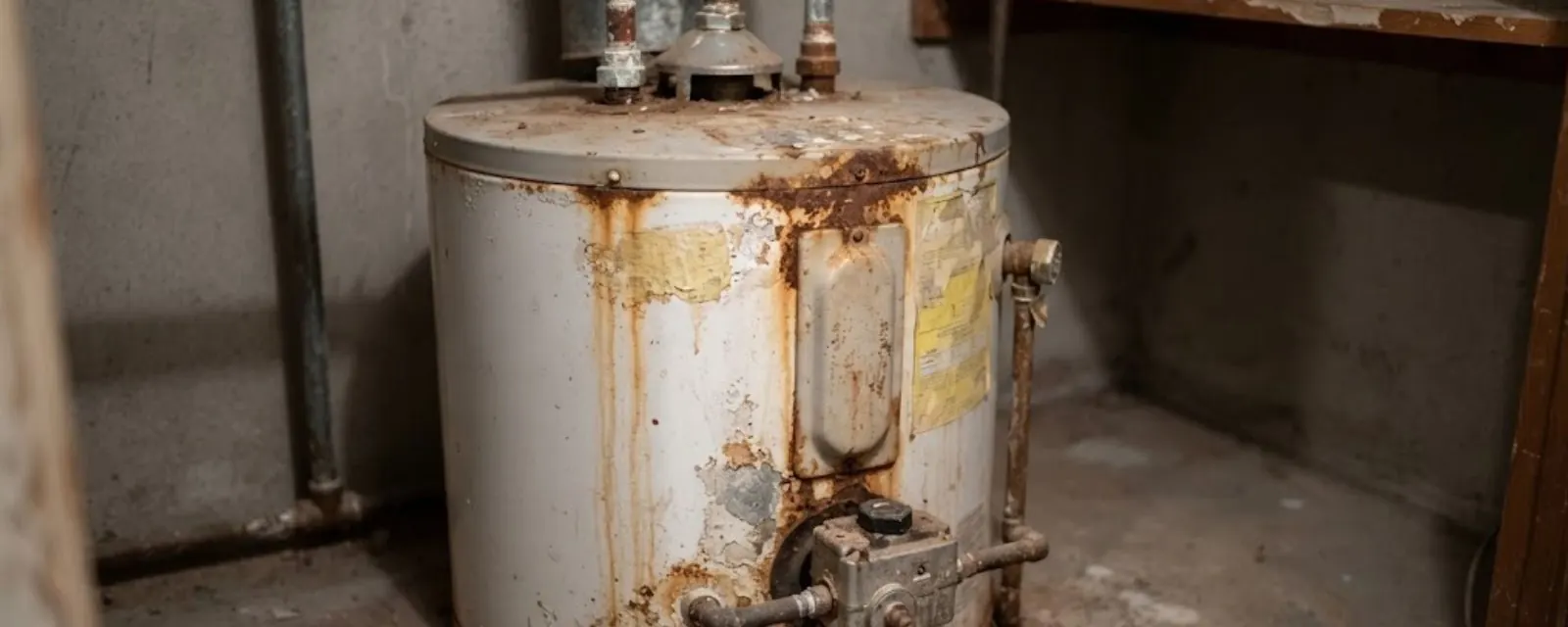
Replace a water heater when the tank leaks, when it needs repeated repairs, or when it can no longer keep up with your household. A leak from the tank body itself is the clearest sign. Metal that has corroded through cannot be patched, and the failure usually gets worse fast.
Other signs are less dramatic. Rumbling, rust-colored hot water, and a pilot or element that keeps failing all build a case. This guide helps you sort a fixable problem from a tired tank.
By the Morristown Express Plumbing team. Published October 30, 2026. Updated October 30, 2026.
Signs the tank is near the end
Watch for these, especially if more than one shows up together.
- Water pooling at the base of the tank, not at a pipe fitting above it
- Rust-colored hot water, while the cold water runs clear
- Popping or rumbling as the burner or element heats sediment
- Hot water that runs out much faster than it used to
- Repair after repair on the same unit
- A tank that is old, with no maintenance record you can point to
Why tanks wear out
Inside a steel tank, an anode rod sacrifices itself to slow corrosion. Once the rod is gone, the tank lining starts to go next. Sediment from minerals in the water also settles on the bottom, insulating the water from the burner or element and wasting energy.
Draining the tank and replacing the anode rod early can extend a heater's life, but only if the steel is still sound. A rod change on a tank that already leaks is wasted effort.
Repair or replace at a glance
A single small fault on a healthy tank favors repair. A failing tank favors replacement.
| Situation | Usually better | Why |
|---|---|---|
| Leak from tank body | Replace | Corroded steel cannot be sealed |
| Dripping relief valve or loose fitting | Repair | Small part, tank still sound |
| No hot water, new element or thermostat needed | Repair | Inexpensive part on a working tank |
| Rust in hot water only, sediment noise | Replace or flush | Tank condition decides |
| Repeated repairs in one season | Replace | Costs accumulate |
Repair or replace
The table below shows how to weigh the common faults.
What to do if it starts leaking
Turn off the power at the breaker or set the gas control to pilot or off. Close the cold water valve above the tank. Keep the area clear and run a hose from the drain valve if water keeps flowing.
A leaking tank is a candidate for water heater replacement in nearly every case. Leaks from a fitting, valve, or relief line are different, and a plumber can often fix them through water heater repair without swapping the whole unit.
Planning a replacement on your terms
Replacing before total failure lets you pick the size, fuel type, and efficiency that fit your household. It also avoids a flooded basement and a cold shower on a weekday morning. Think about how many people use hot water at the same time, whether you want a tank or a tankless system, and whether the venting and gas line are already suited to the new unit.
Ask the installer to haul away the old tank and to confirm the relief valve, shutoff, and expansion needs for your home. Anything that depends on local permits is best confirmed with the town construction office.
Costs hidden inside an old heater
An aging tank loses efficiency as sediment builds up, so you pay more to heat the same water. Sediment also shortens element and burner life. Add the risk of water damage from a sudden failure, and a worn tank costs more than its sticker suggests.
Look at repair history too. One part in several years is normal. Two or three in a single season means the heater is telling you something.
Choosing the replacement
Match capacity to the number of people and fixtures in daily use. Decide between a standard tank, a tankless unit, and a heat pump model, each with different space, venting, and power demands. A heat pump unit needs room and airflow, while tankless needs a suitable gas line or electrical capacity.
Ask your installer about shutoff valves, a drain pan, a relief line, and whether an expansion tank is needed. These details protect the new heater and your floor.
Before the installer arrives
Clear a path to the heater and make sure the old unit is accessible. Know where the main water shutoff is. Take a photo of the data plate so the installer can match connections and fuel. Plan for several hours without hot water on the day.
If the old tank is leaking, shut the water and power first. A towel and a bucket now save a wet floor later.
Safety points around a failing tank
A relief valve that discharges often is a warning, not a nuisance. Do not cap it or plug the line, because that valve is the last defense against excess pressure. Gas units should have clear venting and a steady flame, and a smell of gas means leave the building and call the gas utility or 911.
Scalding water or a tank that feels unusually hot to the touch also deserves a prompt visit. These are cases where waiting for a convenient weekend is the wrong call.
For anything urgent, our 24/7 emergency dispatch can send a licensed plumber, with same-day appointments when available.
Reading the data plate
The label on the side of the tank lists the model, the capacity, and usually a serial number that encodes the build date. Photograph it now.
Manufacturers decode that serial differently, so a plumber or the maker's site can tell you the age in a minute. Age alone does not condemn a tank, but a unit that is well past its expected life with any leak or rust is a poor bet. Pair the date with the signs above, and you can decide calmly instead of during a cold snap.
Morristown, NJ: hard water and tank life
The Southeast Morris County Municipal Utilities Authority blends several sources, and its 2024 water quality report lists hardness between 29 and 400 mg/L, or 1.7 to 23.4 grains per gallon. That is a very wide range. Harder water leaves more scale on elements and tank floors, so two houses in the same town can see very different tank lifespans.
Test your tap or read the SMCMUA report, and ask about a flush schedule. Households in Florham Park should check the bill for the supplier, and homes in Parsippany-Troy Hills are served by a township groundwater system with its own results.
Frequently asked questions
Dry the base and the pipes above it, then watch for the source. Water that keeps appearing from underneath the jacket, not from a fitting, means the tank has failed.
Rust in the tank usually signals corrosion inside, so replacement is more likely. Rust at an external fitting may be a minor repair.
Not always. If it is fine, has been maintained, and your usage has not changed, you can plan ahead without rushing. A replacement before failure just lets you control the timing.
It can be, depending on household demand and installation conditions. It needs a proper venting and gas supply plan, and scale control matters in harder water.
Shut off the power or gas and the water to the tank, then call. We offer 24/7 emergency dispatch and same-day appointments when available.
SMCMUA reported hardness from 29 to 400 mg/L in 2024, so scale buildup is plausible for many homes. Flushing the tank on a schedule helps.