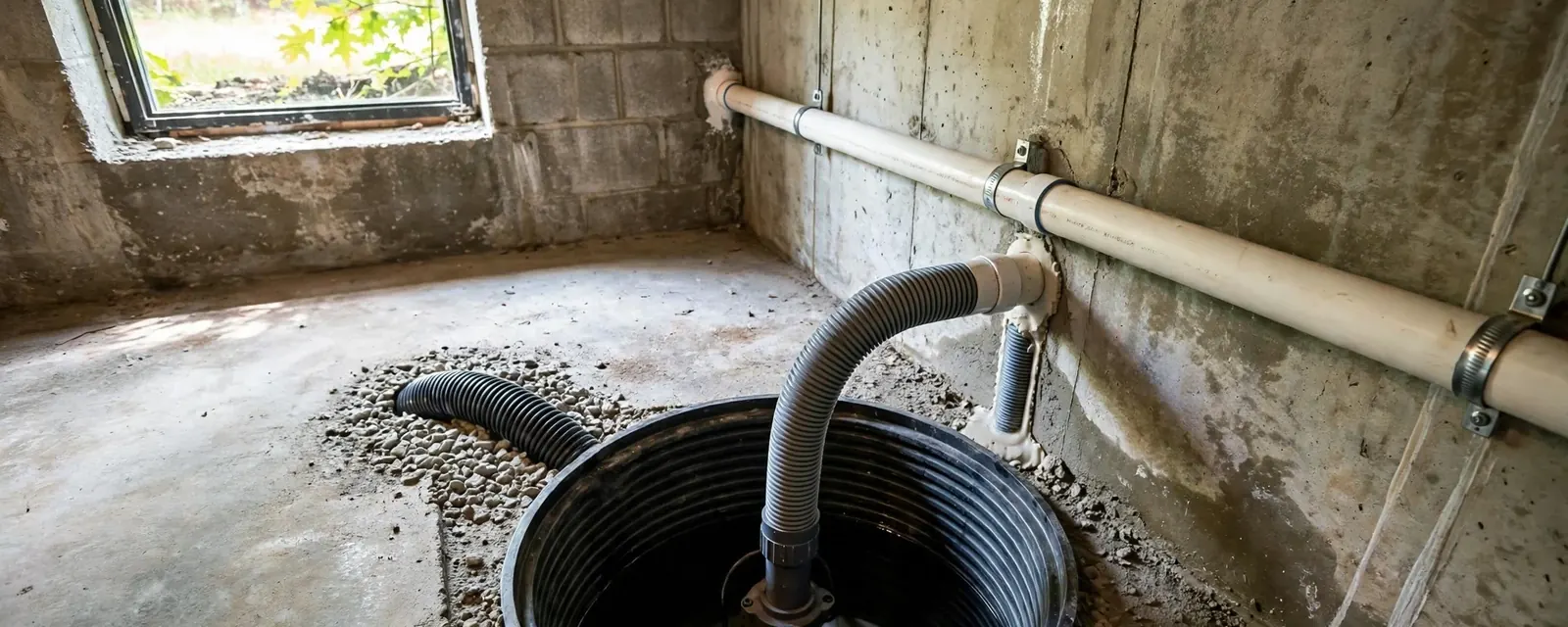
Yes, a handy homeowner can install a sump pump, but only the easy version. Replacing a failed pump in an existing pit takes a couple of hours, a check valve and a clean discharge line. Cutting into a basement slab to create a new pit, tying into drain tile, or choosing where to send the water is a bigger job that deserves a licensed plumber.
The cost of getting it wrong is a flooded basement on the day it rains hardest. Before you start, decide which job you actually have, because a pump that is wired wrong or discharges to the wrong place can fail exactly when you need it.
By the Morristown Express Plumbing team. Published October 30, 2026. Updated October 30, 2026.
Which kind of job do you have
A swap means there is already a pit, a discharge pipe and an outlet. You are only exchanging the pump. A new install means no pit exists, so someone must break the floor, dig, set a basin, and run a discharge to the outside.
Be honest about the second job. Breaking a slab raises dust, can hit existing drain tile or pipes, and needs correct sizing for the basin. Many homeowners are better off hiring that part and doing the cleanup themselves.
Tools and parts to gather
For a swap, have these ready before you shut anything off.
- A submersible pump sized to your pit and your water load
- A new check valve and rubber couplings with clamps
- PVC pipe, primer, cement and a short length of spare pipe
- A bucket, a wet vacuum, towels and a flashlight
- A battery backup pump, if the basement has important belongings
- A GFCI outlet for the pump plug, with no extension cord
DIY or call a plumber
A quick guide to splitting the work.
| Job | DIY reasonable? | Why |
|---|---|---|
| Swap a failed pump in an existing pit | Often yes | Pit and discharge already exist |
| Add a battery backup pump | With care | Needs correct wiring and space |
| Cut a new pit in the slab | Rarely | Dust, drain tile, sizing and permits |
| New discharge line outside | Sometimes | Routing and winter freezing matter |
| Repeated flooding with no pump failure | No | Cause needs diagnosis |
Choosing the right pump
Pedestal pumps sit above the pit and are easier to service, while submersible pumps sit inside and run quieter. Most homeowners with a standard pit choose a submersible model because it handles heavier flows and stays cooler under load.
Size matters. A pump too small cannot keep up in a downpour, and one too large short-cycles and wears out early. Read the pit depth, the incoming water pattern and the lift to your discharge point, then match the pump to those numbers instead of choosing by price.
Steps for replacing a pump
Unplug the old pump, then disconnect the discharge pipe at the union or coupling. Lift the pump out, remove debris from the pit, and note how deep it sits. Attach the new check valve to the discharge so water cannot fall back into the pit.
Set the new pump on a flat base, away from the pit wall, and make sure the float can rise freely. Reconnect the pipe, plug in, and pour a bucket of water into the pit to test. The pump should start, empty the water, and shut off cleanly.
Discharge, the part that goes wrong
Pump water must go somewhere that does not circle back. Point it away from the foundation and neighbors, and keep it separate from the sanitary sewer. Rules on where it may discharge vary by town, so ask the town construction office before you decide.
Winter adds another risk. A discharge pipe that freezes will push water back into the pit, and the pump runs without relief. Keep the outlet open and sloped so it drains between cycles.
Mistakes that flood basements
The most common mistakes are no check valve, a pump too small for the pit, a stuck float, and power that fails with no backup. Another is plugging the pump into a shared outlet that trips.
Test the pump twice a year and before big storms. If it runs constantly, short-cycles or hums without pumping, something is wrong with the float, the valve or the pump itself.
Testing and maintenance routine
Twice a year, pour water into the pit until the float lifts and confirm the pump starts. Listen for grinding, and check that discharge water flows outside. Clean the intake screen and remove silt from the pit.
After a large storm, check the pit again. A pump that handled the storm may still have debris jammed in the float, and finding it now beats finding it in the next rain.
Electrical safety you cannot skip
The pump should run on its own grounded outlet protected by a ground fault interrupter. Never splice the cord or run it through an extension cord, and never stand in water while handling the plug.
If you are unsure about the outlet or panel, hire an electrician. Plumbers can handle the pump and discharge, but wiring problems belong to the right trade.
When to hire a plumber
Call a licensed plumber when you need a new pit, when the basement floods regularly, when you cannot find where the water enters, or when the electrical setup is questionable. Water, pumps and household current are an unforgiving combination.
A professional sump pump installation covers sizing, the check valve, the discharge and a backup system. For flooding that keeps returning, discuss basement waterproofing, since a pump alone treats the symptom.
If the pit is full and the pump has failed
Stay out of standing water if the basement outlets or appliances are submerged, since electricity and water do not mix. Shut off power at the panel only if you can reach it without stepping in water.
Move valuables upward, use a wet vacuum or bucket where safe, and call for help. Same-day appointments are available when schedules allow.
Morristown, NJ: why the river gauge matters to your basement
On October 30, 2017, the National Weather Service gauge on the Whippany River in Morristown, behind the shopping center on Cedar Knolls Avenue, read 5.11 feet at 8:15 a.m., up from 1.9 feet the day before. Patch reported that flood action stage and that minor flooding begins at 6 feet.
A rise that fast shows how quickly groundwater and runoff can load a basement in a nor'easter. Test your pump before a forecast like that, not after. We also serve Morris Township and Parsippany-Troy Hills, where the same river system runs.
Frequently asked questions
It varies with use, water quality and quality of the pump. If yours is old, noisy or cycles constantly, plan a replacement before storm season instead of waiting for failure.
If the basement holds valuables or finished space, a backup is wise. Storms that flood basements often also knock out power.
No. Sump water should not go to the sanitary sewer, and many towns prohibit it. Ask the town construction office about the approved discharge in your area.
A high water table, a stuck float, a leaking supply line or a failing check valve can all cause it. Have it diagnosed if it runs for hours.
No. A pump removes water that collects in a pit. Waterproofing aims to keep water out or direct it, and some homes need both.
A backup is sensible for any basement with finished space, and the river's quick rise in the 2017 storm shows how fast conditions change. Ask a plumber to size it.